Graphics Interface 2026 · Waterloo, Canada

Development and Evaluation of Sensor-Powered Wireless Smart Wooden Panels

Yuning Su, Bofan Yu, Tingyu Zhang, Yonghao Shi, Te-Yen Wu, and Xing-Dong Yang

Proceedings of Graphics Interface 2026

PDF
Demo video. Fabricating an AccelLumber panel, harvesting power from beneath the floor, and sensing activities on the completed furniture.

Abstract

We explored the technical feasibility of wireless smart wooden panels that integrate conventional sensors and electronics. Prior work has explored either embedding wired, off-the-shelf electronic components in wood or enabling wireless energy transfer, but supporting both simultaneously using existing technology has remained uncertain. Following a validation-through-implementation approach, we developed AccelLumber, a prototype that leverages a commodity RF-based wireless power transfer system to continuously power off-the-shelf sensors and electronic components within wooden furniture panels. We evaluate its performance across panel scalability, power infrastructure requirements, and activity recognition. Our results demonstrate that wireless smart wooden panels are not merely a conceptual idea, but a viable approach to realizing smart environments.

System

Turning a wooden panel into a wireless sensing surface

AccelLumber embeds a receiver array, power-management electronics, Bluetooth communication, and a three-axis accelerometer inside a furniture-grade panel. An RF transmitter hidden beneath the floor supplies continuous power, so the finished surface can sense activity without a wired connection or a battery that needs recharging.
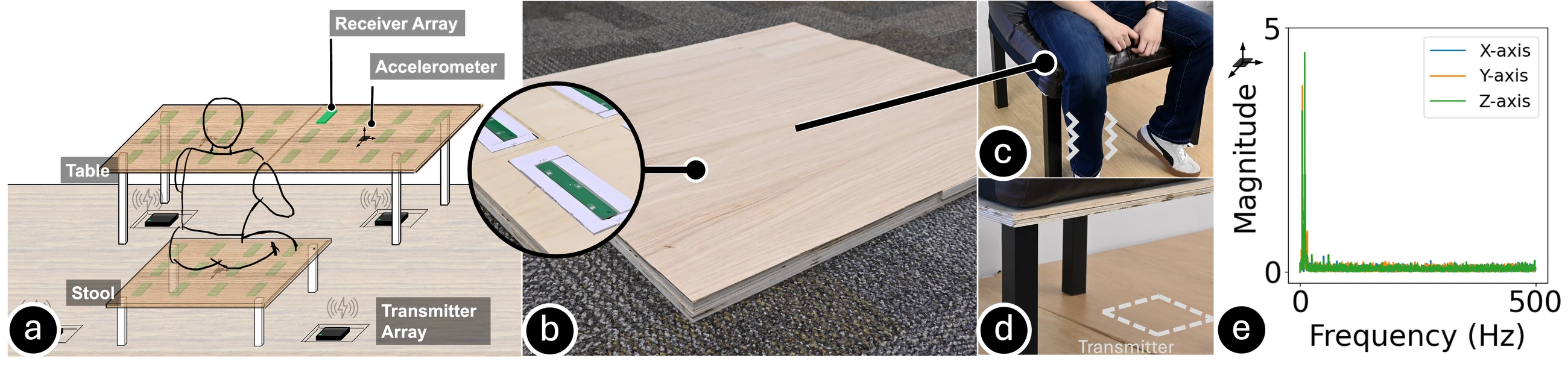
AccelLumber overview showing wirelessly powered furniture, the embedded panel, a person shaking a leg on a stool, the floor transmitter, and the resulting accelerometer signal
Figure 1. System overview: underfloor RF power reaches embedded receiver antennas, enabling a finished wooden panel to capture activities such as leg shaking through its accelerometer.
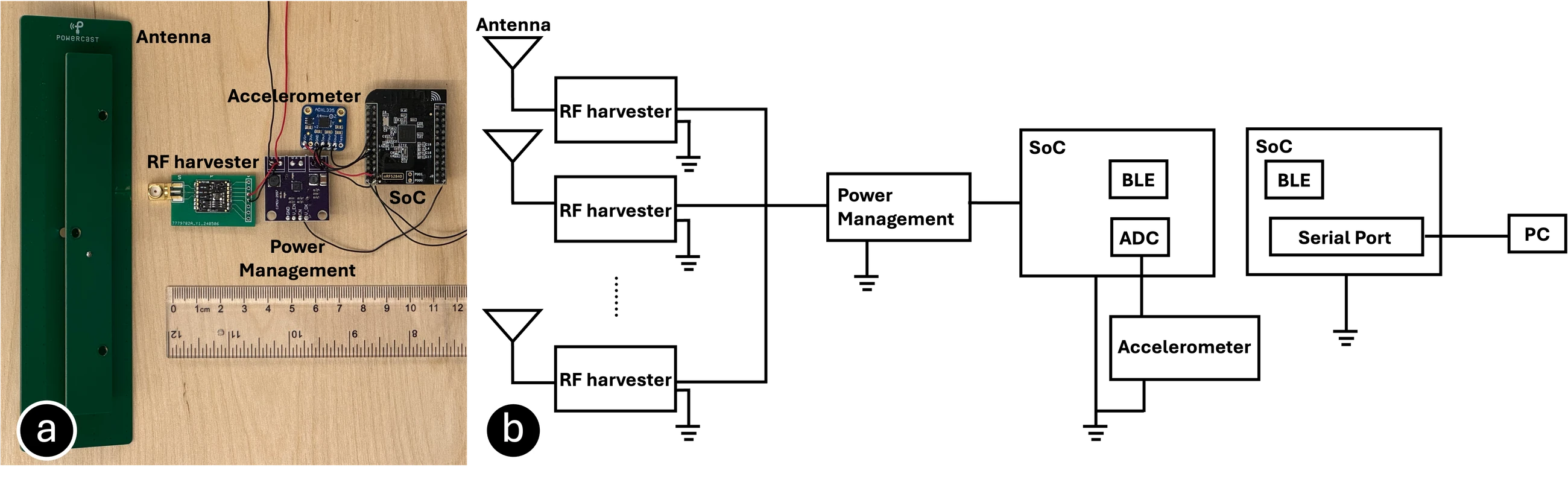
Top view of the AccelLumber electronics and a circuit diagram of its antenna, RF harvester, power management, accelerometer, and system-on-chip
Figure 2. The prototype combines a Powercast RF harvester, BQ25570 power-management unit, ADXL335 accelerometer, and nRF52840 system-on-chip. Multiple antenna–harvester pairs feed the same sensing and communication stack.
Three-stage AccelLumber fabrication process showing antennas in a plywood layer, patch antennas and reinforcement, and the finished wood-grain surface
Figure 3. Fabrication layers the antenna array and electronics between plywood sheets, reinforces the cutouts, and finishes the surface with wood-grain material so it can be used like an ordinary panel.
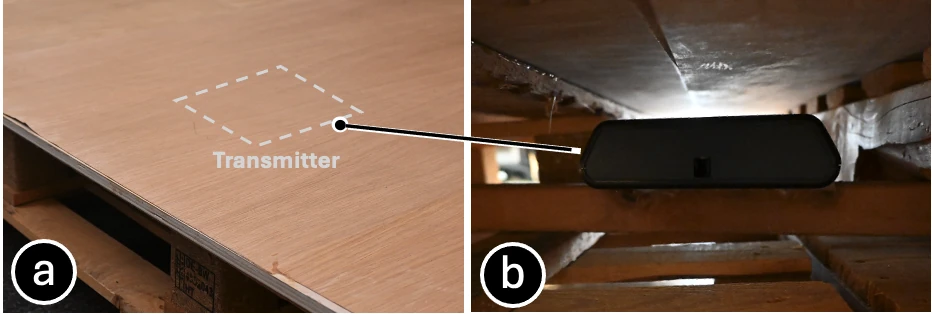
Raised plywood lab floor and RF transmitter installed inside the support structure beneath it
Figure 4. The transmitter sits inside a raised floor, approximately 3 cm beneath the plywood surface, keeping the power infrastructure out of sight.

Power characterization

How panel size and furniture height affect coverage

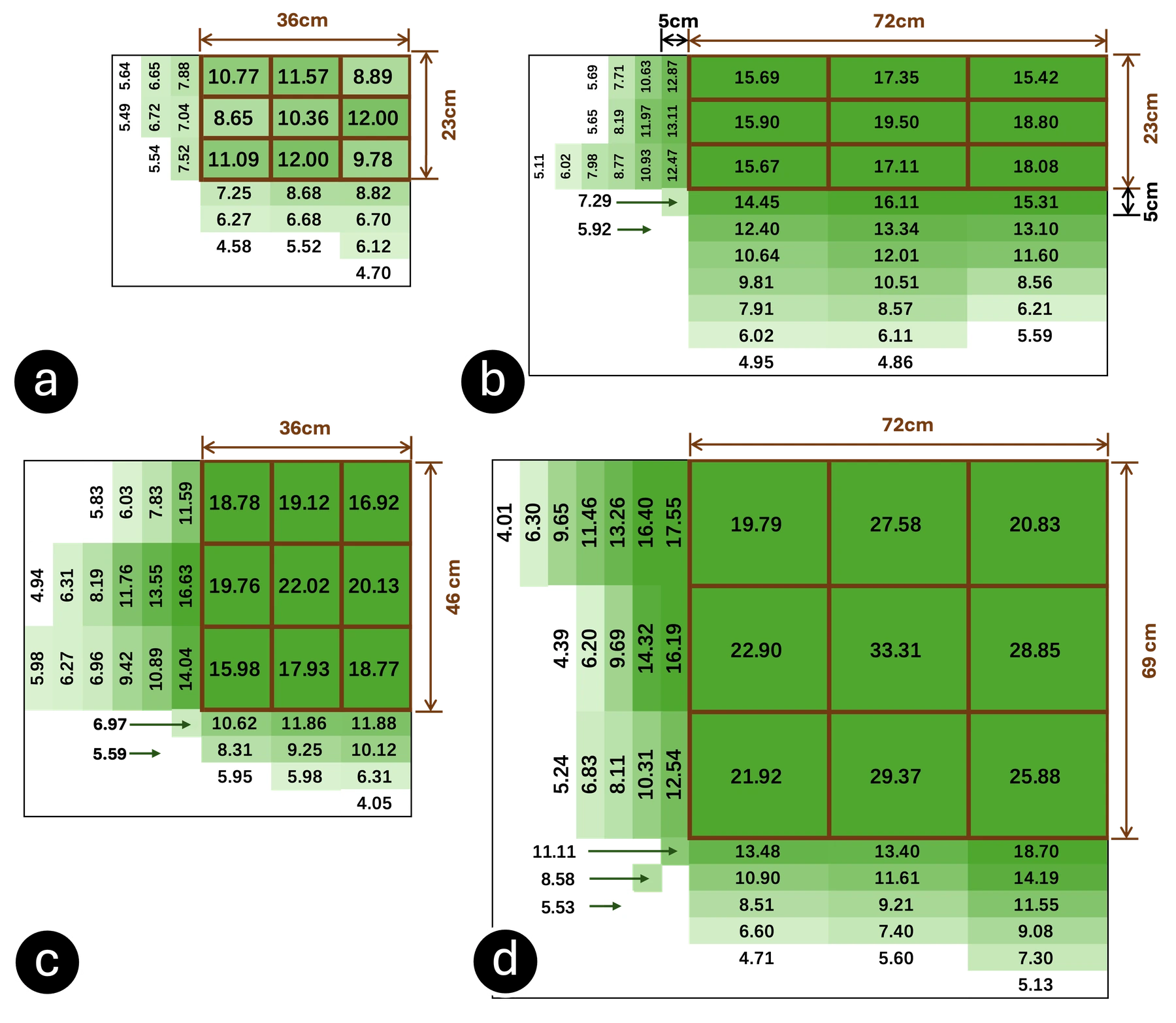
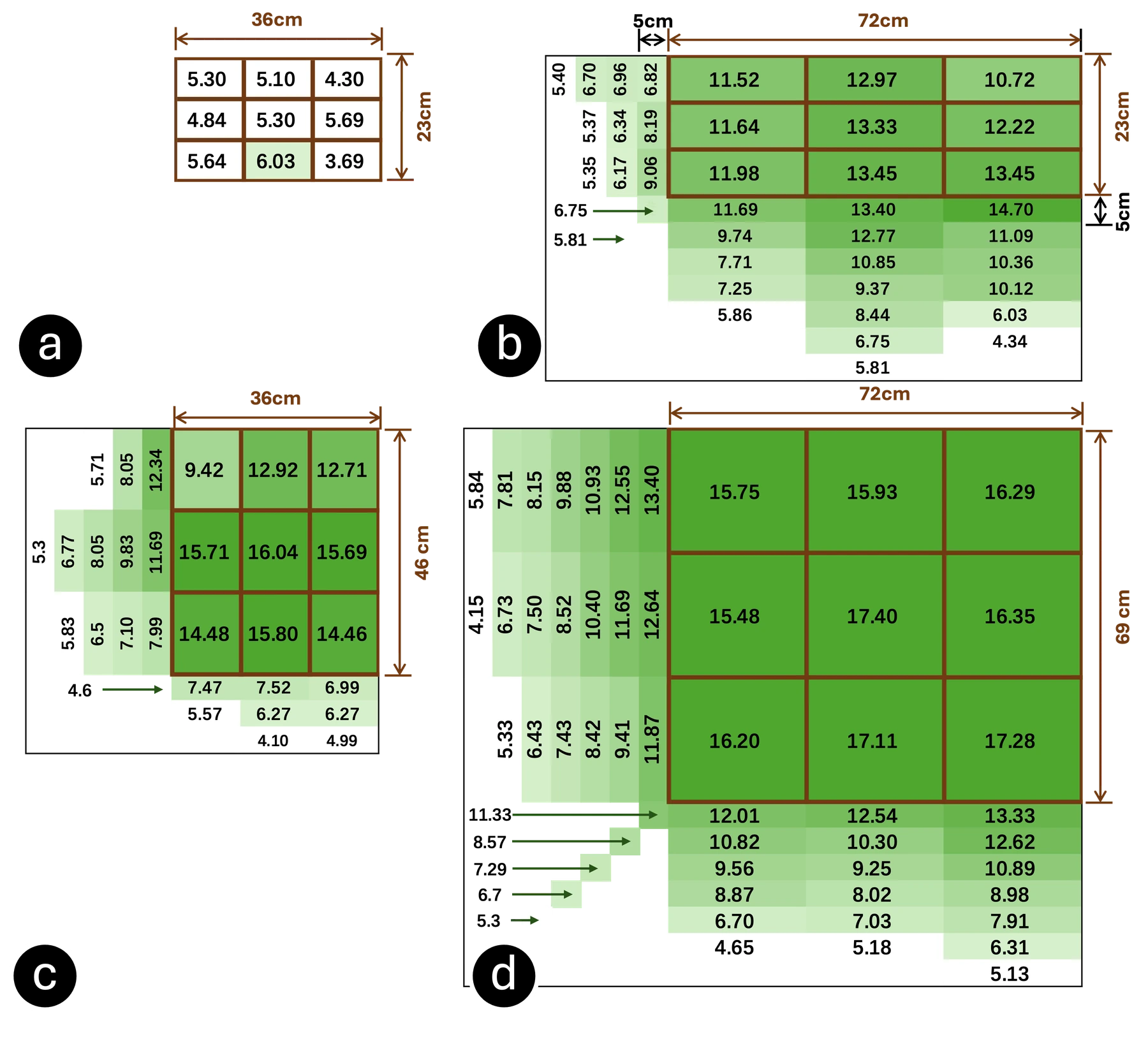
We measured four receiver-array layouts while moving the underfloor transmitter across and beyond each panel footprint. Green cells mark locations that met the prototype’s 5.98 mW operating requirement. The comparison shows why antenna count—not only distance—matters when scaling from stools to desks and tables.
Power-coverage maps for four receiver antenna arrays with the transmitter 50 centimeters below the panel
Figure 5. At 50 cm—the approximate height of a stool seat—even the compact 1 × 2 array can supply enough power across its footprint.
Power-coverage maps for four receiver antenna arrays with the transmitter 80 centimeters below the panel
Figure 6. At 80 cm—a typical tabletop height—four antennas in either a 1 × 4 or 2 × 2 layout are needed for reliable operation across the array footprint.
Coverage result

The 3 × 4 panel harvested an average of 25.6 mW at 50 cm and 16.4 mW at 80 cm—both comfortably above the 5.98 mW required by the sensing system.

Furniture demonstrations

Built with familiar woodworking operations

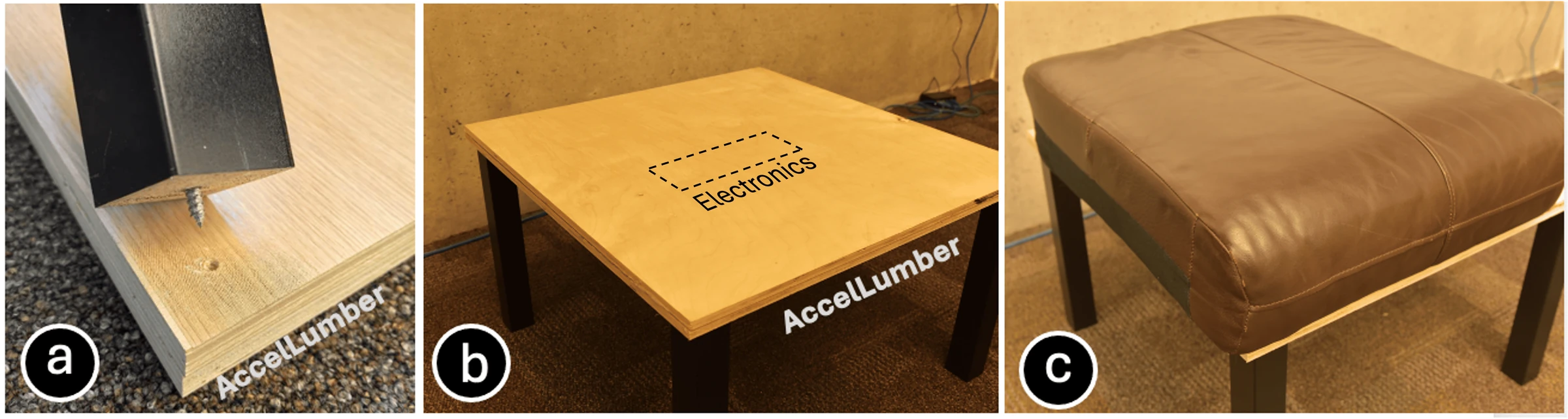
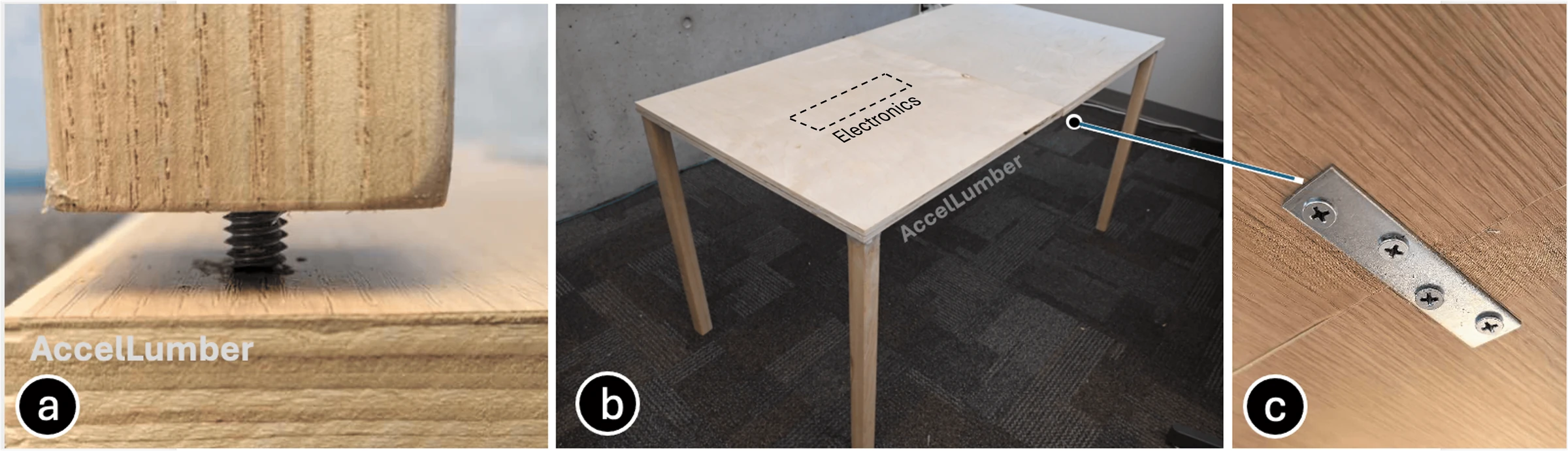
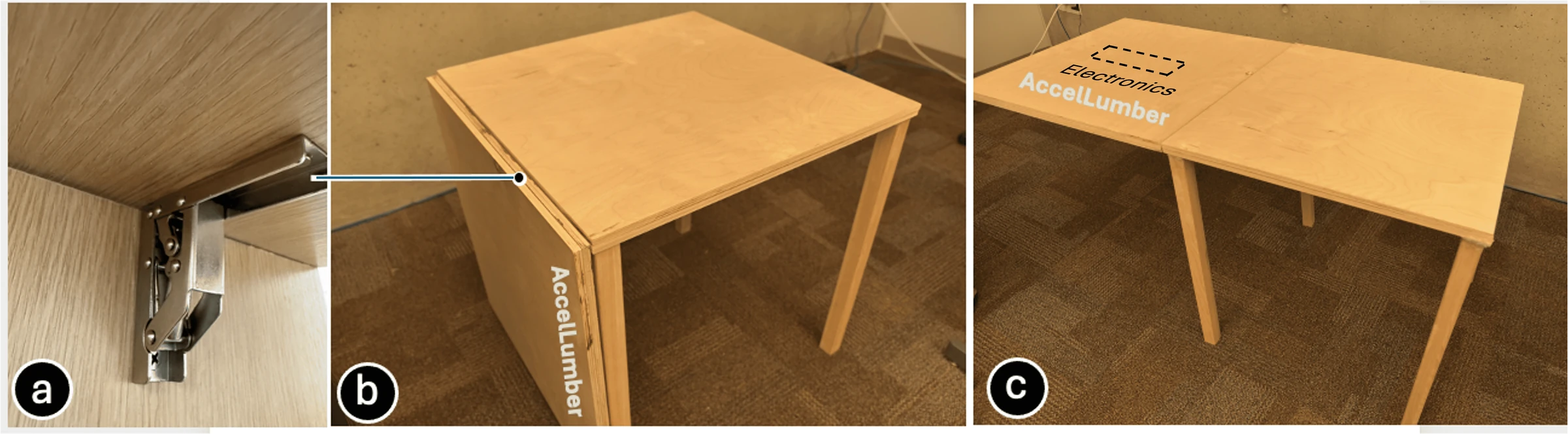
To test whether the panels still behave like a practical building material, we used screws, pilot holes, braces, hinges, and off-the-shelf legs to construct three pieces of furniture. Reserved margins protect the embedded antennas while allowing AccelLumber to join standard wood panels and hardware.
Desk construction showing a leg attached to an AccelLumber panel, the completed desk, and flat braces joining panel sections
Figure 7. A desk combines an AccelLumber panel with a standard plywood panel. Flat braces enlarge the usable surface, while legs attach within marked screw-safe zones.
Drop-leaf table showing its hinge, folded position, and extended flat surface
Figure 8. In a drop-leaf table, the sensing panel doubles as the movable leaf. Its accelerometer can directly detect the opening and closing motion.
Stool fabrication showing an attached leg, the completed AccelLumber stool, and the stool with a cushion
Figure 9. A cushioned stool demonstrates that the panel can remain wirelessly powered from below while supporting an ordinary upholstered surface.

Activity recognition

One model across a desk and a stool

Ten participants performed 13 appliance, tool, cooking, office, and seated activities. The study deliberately trained one model across both furniture types—including actions on an adjacent uninstrumented wood panel—to test whether the sensing approach could generalize beyond a single object or surface location.
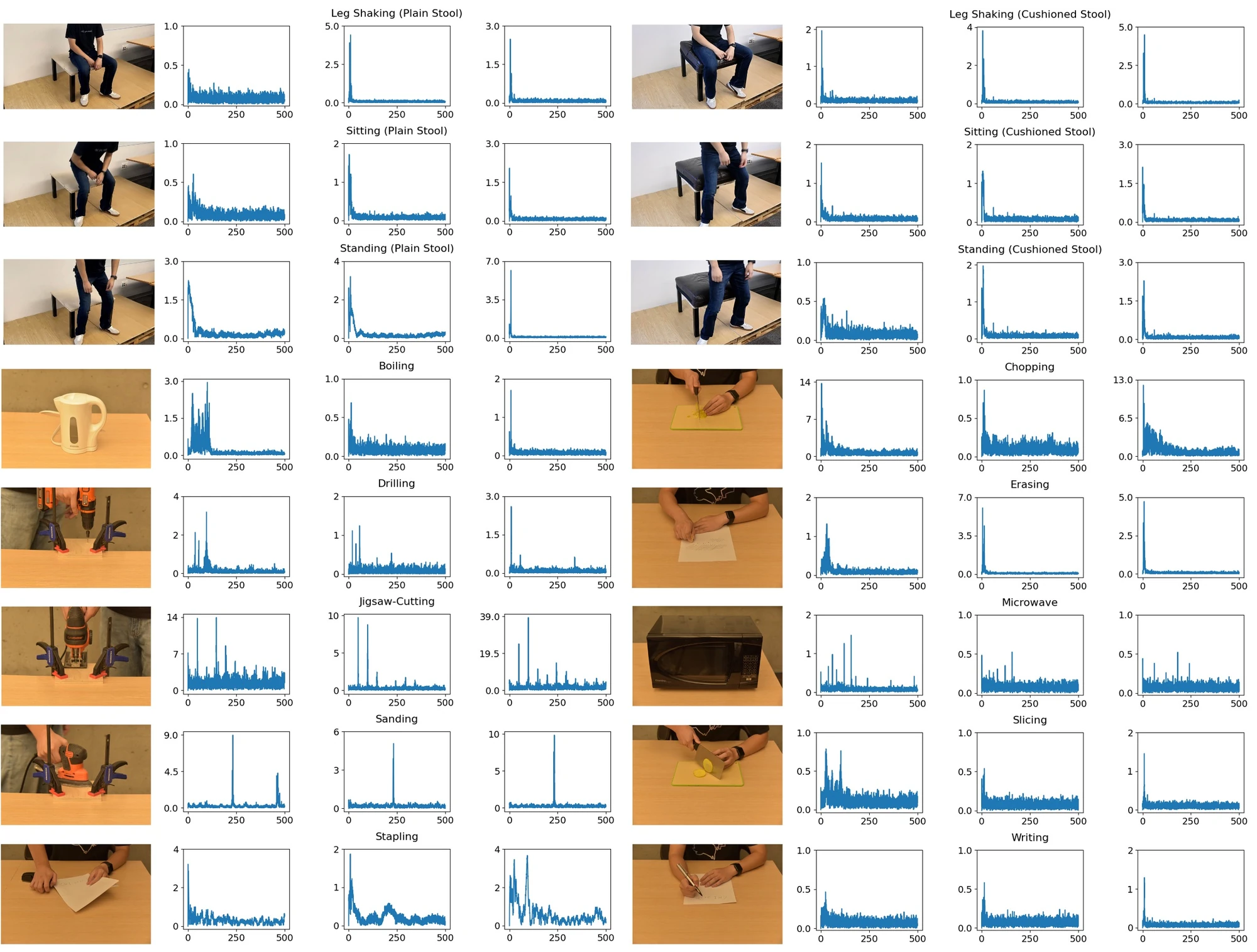
Thirteen desk and stool activities paired with their X, Y, and Z accelerometer frequency signatures
Figure 10. The tested activities produce distinct three-axis frequency signatures, from appliances and power tools to writing, sitting, standing, and leg shaking.
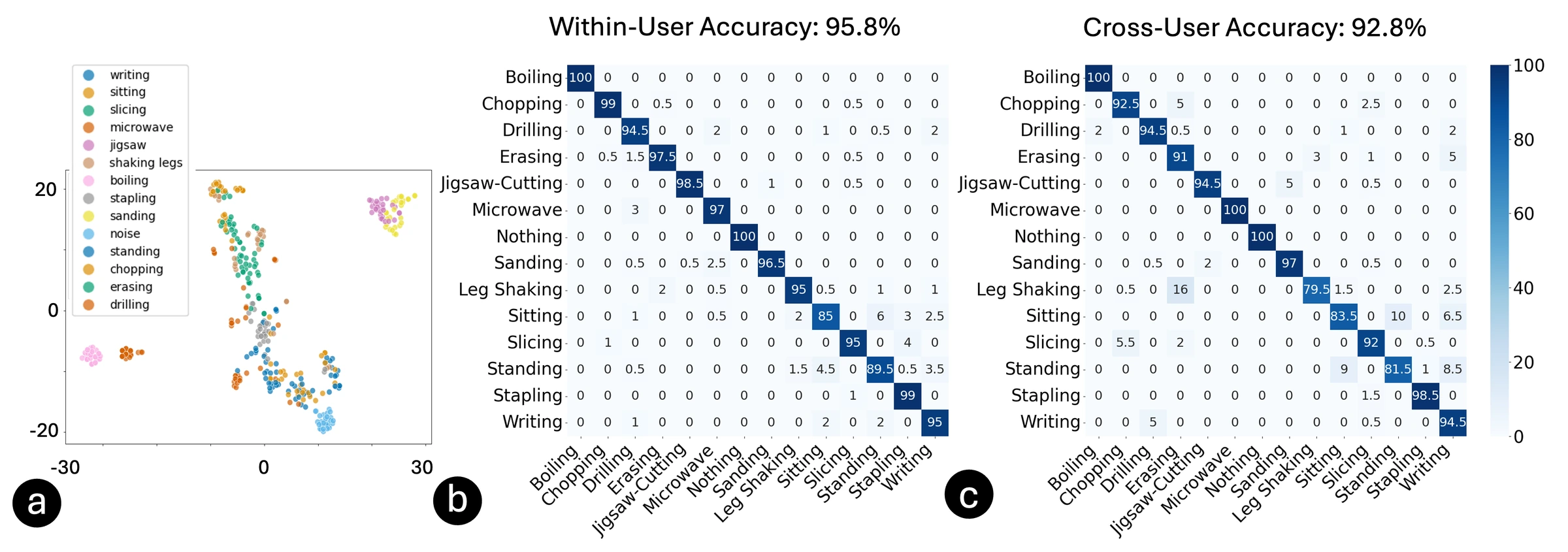
A t-SNE activity embedding and confusion matrices for within-user and cross-user activity recognition
Figure 11. Activity embeddings and confusion matrices show strong separation across most classes. The model reached 95.8% within-user accuracy and 92.8% cross-user accuracy.
Recognition result

High accuracy was maintained while the entire sensing and communication system ran on harvested RF energy, including trials performed on regular wood joined to the powered panel.